

Bali Myna takes flight to Nusa Penida (Dijkman, June 2007)
Despite long-standing endeavours to salvage the critically endangered Bali Myna Leucopsar rothschildi from the hands of unscrupulous traders and status-conscious politicians, its numbers have dwindled in the past couple of decades to only a handful (see Birdlife International 2001).
Very recently, however, a number of these popular birds have found a new haven on the island of Nusa Penida and are breeding and producing offspring in surprisingly new ways. Besides the Bali Myna, other endemic birds profit from a successful nature conservation project as well. Thanks to this comprehensive programme, undertaken in cooperation with the island’s inhabitants, both the local flora and fauna are getting a new chance of survival.
read more
Nusa Penida
The open and mountainous landscape of Nusa Penida is surprisingly different from mainland Bali. In comparison, Nusa Penida is quiet, hot and arid. Indeed, the countryside seems to have more in common with the dry islands further east, such as Sumba and Sumbawa. No wet rice cultivation is to be found on this ‘magic island’, where the main source of sustenance is seaweed. Nusa Penida is also famous amongst the Balinese for its Hindu Temple at Ped, where people return frequently every year for a spiritual journey to experience the healing powers from the local gods. Others say that the island is home to magical forces, black magic and ill omens. The ubiquitous teak trees, with their unmistakable large leaves – evidently oblivious to the island’s reputation – thrive on this dry and infertile soil.
Up in the mountainous area of Hutan Tembeling, near the village of Batumadeg, lies a long strip of pristine forest, meandering down towards the sea where a clear stream at the bottom of a ravine trickles into a natural swimming pool. It’s the dry monsoon, and on the way up the hills, the promised Sabuluh waterfall is hardly discernible. The pool, however, is filled with crystal-clear water and a delight to swim in. Surrounded by a large school of curious gray fresh-water fish, one hardly notices the presence of more-than-curious shrimps; these small and gentle creatures seem quite unperturbed by casual waders. The trees and shrubs around the pool, next to a modestly designed white cave temple, give shelter from the hot midday sun, high above, where the canopy forms a padded blanket through which enough light filters down to observe the surroundings. The narrow path leads further down over layers of thick foliage and through dense undergrowth. Part of the trail is still used by the local farmers for their livestock, to find water half way down. Further down still, the trail descends more rapidly where apparently cows find it too unsafe to wander, ending at a pebbled beach studded with huge boulders. Suddenly, one gapes at a tumultuous ocean, with waves as high as a house, breaking violently against the steep cliff with thunderous noise. The view to the Indian Ocean is spectacular; there is a high and thin piece of land separated from the mainland to the right and in this snug bay of light the colour of the sea is enriched with every hue of blue. Wary, however, of its ominous waves, it is perhaps wise to let oneself be captivated by its beauty at a safe distance, on top of a few rocks close to the forest edge.
Virtually extinct
Bayu Wirayudha, Balinese initiator of this nature conservation project, with grains of blessed rice on his forehead is radiant and all smiles. He has reasons to be truly proud, for he has been running the Nusa Penida Bird Sanctuary (NPBS) since May 2004, and is working alongside the local population to enhance their chances of a better life. He is, in fact, a bit of a busybody ‘millipede’. Apart from running the Bird Sanctuary, he is also a veterinarian, founder & director of Friends of the National Parks Foundation and director of Begawan Giri Foundation’s Environment Division. He reckons that close cooperation with the local population is indeed the only way to guarantee the survival of the newly introduced fabled symbol of Balinese fauna. This gorgeous bird, in Indonesian ‘Jalak Bali’, with its tufted white crest, snow-white plumage and black wing- and tail-tips sports a pair of blue spectacles in truly magnificent fashion. Apart from its illustrious physical beauty, its endearing behaviour and chirpy voice have made this mynah one of the most sought-after birds in all of the Indonesian archipelago, leading to its near extinction (it was only placed on CITES Appendix I on 1 July 1975). The natural habitat of the Bali Myna is not Nusa Penida, but the West Bali National Park where as few as five birds survive today. The conditions there are far from ideal, despite numerous costly national and international programmes to protect this bird and to monitor its breeding in the wild. Negligent wildlife management, illegal hunting and dubious political games seem to have caused the current dire state of affairs.
Breeding and release
On 10 July 2006, 25 Bali Starlings were released at various locations in Nusa Penida. These birds are the result of a non-commercial breeding project initiated by the Begawan Giri Foundation and the Friends of National Parks Foundation (FNPF). The in-situs breeding of the Bali Starling has been the main activity of the Begawan Giri Foundation since 1999, the year of its inception. Various measures have been taken to ensure the success of this release programme. The most striking of all, perhaps, is the fact that an overall agreement was reached by mid 2005 between the 35 villages on the island, the two foundations and the Balinese state authorities involved in nature conservation. To guarantee the safety and survival of the birds, prior to the release date, the birds were ‘offered’ to the gods by means of a series of religious ceremonies performed by Hindu priests. This way, the gods were asked to give protection to the birds after their release since they no longer are the possession of humans, but are entrusted into the hands of the divine. Secondly, traditional Balinese law (Awig-awig) provides a good basis for their protection as well. This law has a strong foothold within rural Balinese society and sanctions have been seen to deter potential illegal bird catchers. Alongside religious and social protection, the Bali Starling enjoys the co-operation from the port authorities, part of the formal Indonesian Legal System on the island, who agreed to keep a close watch on illegal trafficking and bird trade.
Community development and reforestation
As part of an integrated approach to ensure the survival of the Bali Myna in the wild, a large section of the Nusa Penida Bird Sanctuary at Ped has been made available for reforestation purposes. The FNPF has been nursing around 50,000 young plants which are being grown and prepared for distribution all over the island at the onset of the rainy season in December. Together with the population on the island, a number of trees have been selected for future use by the people themselves, such as teak Tectona grandis, mahogany Swietenia mahagoni, sugarpalm Arenga pinnata and an especially strong bamboo variation named Guadua BambooGuadua angustifolia to be imported from Colombia, South-America. This bamboo species is considered the strongest in the world and provides excellent construction material. People can grow these for production in order to generate income. Apart from these, it is expected that the introduction of jatropha trees Jatropha curcas, an alternative source for biodiesel, will contribute towards better sustenance for the locals. Of course, together with other plant species, two other objectives are achieved: reforestation of particularly arid and vulnerable areas and a source of food for the birds. The “delundung” Erythrina lithosperma, a sacred tree of the same family as the bright red flowering Coral Tree, will harbour large quantities of insects and provide ample nesting space. Other examples from a long list of trees and plants to be distributed amongst the local population of Nusa Penida are the various ficus subspecies including the sacred ‘beringin’Ficus benjamina.
A project of this size could not have been a success without additional support activities such as educational programmes, both in-house and at schools around the island, and general promotion amongst the local population. Special youth clubs have been formed to organize trips into the interior, where birding contests are held, and awareness is raised on the preservation of our natural environment. All of these and many more activities will be continuously staged by some nine permanent and a handful of freelance staff members who are only willing to call their project a success if more than 100 Bali Mynas are freely flying around the island. The project enjoys financial support from the Gibbon Foundation Indonesia.
Breeding results
Presently, the released Bali Mynas are breeding and producing offspring in their newly adopted natural habitat. The survival rate of the released birds is high, with – until the time of writing – only one death amongst 25 birds. Oddly, however, and seemingly in contradiction with what was known of their natural behaviour in the wild, they seem to be adapting quickly and finding alternative nesting places. Most studies have it that the Bali Myna only nests in pre-formed tree-holes, ones left for example by barbets and woodpeckers. One pair of Bali Mynas in Nusa Penida, however, has chosen an ordinary coconut tree, another pair has found its home in a sugar-palm and two pairs are seen to have established themselves in one and the same ‘punga-punga’ tree Ficus sp. near the village of Saren (Batumadeg). The pair nesting in the sugar-palm has raised two chicks that are (at time of writing) ready to leave their home, and have been observed making their first attempts to get airborne. In total, two pairs have successfully produced offspring. Other nesting sites used by the Myna are beehives and artificial nest boxes attached to fig trees. This alternative breeding behaviour is unique, since apparently they have shifted away from their supposed territorial habits, and have accepted entirely different conditions for their offspring. In fact, the Balinese are delighted to find one pair investigating the niches of a Hindu temple, also at the village of Saren, in search of a suitable nesting place. Unfortunately, no offspring has been raised here so far. The local community, however, has shown its commitment in protecting the released birds and has joined the team of conservationists in their continuous efforts to monitor them. The conservation team believes, therefore, that the island of Nusa Penida has proved a suitable area for the Bali Myna release programme.
Birding
At Nusa Penida, there are interesting possibilities for birding excursions. Apart from the Bali Myna, you’re likely to see the endangered Yellow-crested Cockatoo (Cacatua sulphurea parvula),hordes of Sooty-headed (Bulbul Pycnonotus aurigaster), and raptors amongst which the Brahminy kite (Haliastur indus). Once you reach the top of the area around Tembeling Forest (Desa Batumadeg), you will be able to observe the Bali Myna (and their young chicks!) from a cool and sheltered birding post, close to one of the large enclosures from which the birds are reintroduced into their new surroundings. The latest bird to be introduced on the island is the Java Sparrow Padda oryzivora, which was released in September as it is another of the endangered bird species in Indonesia.
Future prospects
The future has much in store for the island. It is expected that with the success of this breeding, reforestation and community development project, ecotourism will stand a real chance on the island. Bayu is considering the possibility for a camp site up in the mountains, hiking and birding trails. This will further benefit the local economy and general development of the island.
There are several other very important bird species presently to be found on Nusa Penida, and one of these is the endangered Black-winged Starling Sturnus melanopterus. The island is the only location where it is known for sure that the species survives in the wild. Ironically, the bird was introduced to Nusa Penida in 1986 by President Soeharto when he officially opened the water catchment basins on the island; apparently, the birds were released from a helicopter! At present it is still a rare sight but it is on the rise, since it too profits from awig-awig law discussed above. Unfortunately, no recent survey has been organised to estimate the size of the population, but the NPBS is gathering information. Based on casual observations, Bali Mynas and Black-winged Starlings do not seem to interact significantly on Nusa Penida and are not considered competitors for food or nesting sites. Food here is abundant for both species and they appear to live together side by side peacefully except for one occasion where paired-up Bali Mynas were seen to chase Black-winged Starlings from their territory. Much like the Bali Myna, the Black-winged Starling has chosen alternative sites and instead of using tree-holes it now finds nesting spaces virtually anywhere, including holes in limestone cliffs.
Reports from villagers and farmers indicate that the Black-winged Starling is to be found around Wates (the remote south-east corner of Nusa Penida), Sedihing (where three Yellow-crested Cockatoos live, south-east), Guyangan, Saren (at the release site of the Bali Myna, Tembeling forest, south-west), around Banah Point (magnificent cliffs, south-west), and Nusa Ceningan (the smaller sibling of Nusa Penida to the north-west).
Apart from the breeding programme for the Bali Myna, a similar integrated breeding project was set up for the Mitchell’s Lorikeet (Trichoglossus haematodus mitchelli) about a year ago. This bird, like the Bali Myna, is a native to Bali but disappeared there in 1988. Sadly, no efforts have been made to red-list the lorikeet for official protection. At present, there are 35 lorikeets in captivity at the Nusa Penida Bird Sanctuary and they too may be hugely important for the survival of the three plain red-breasted, indigo-bellied subspecies of the westernmost end of the lorikeet’s range. Consideration is being given to the release of some of these birds on Nusa Penida in the future.
Last but not least of the endangered bird species, a few Yellow-crested cockatoos still live on the island. Their numbers have decreased sharply since 1965, owing to trapping, loss of habitat and nesting locations. One pair lives in a gigantic sacred “stinky sterculia” Sterculia foetida in Karanggede, not far from the Bali Myna release locality, and have chosen a hole in this tree right underneath the nest of a pair of Brahminy Kites. Not a very favourable location, one could argue… but perhaps here as well, very much like the Bali Myna itself, the birds feel protected by the local deities, since this majestic tree stands on the grounds of a beautifully located temple, on the edge of a steep cliff, with a view to an indigo-blue ocean that is situated between Bali and this enchanting island of Nusa Penida.
References
• BirdLife International (2001) Threatened birds of Asia: the BirdLife International Red Data Book. Cambridge, UK: BirdLife International p.2375-2391
• FNPF & Begawan Giri Foundation, Pelepasliaran dan Perlindungan Burung di Kepulauan Nusa
• Penida, Nusa Penida Bird Sanctuary Activity Report, April–June 2006 (unpublished)
• MacKinnon, J., Field Guide to the Birds of Java and Bali, Gadjah Mada University Press, 1991
• Ruggles, A., Lories & Lorikeets, The brush-tongued parrots & their care in aviculture, Blandford London 1995
• Sugiarta, M. interviews (veterinarian & site manager at Nusa Penida Bird Sanctuary), July-December 2006, Nusa Penida & Bali (Indonesia)
• Sujatnika et al, Indonesia, Conserving Biodiversity: The endemic bird area approach, PHPA/Birdlife International-Indonesia Programme, Bogor 1995
• Setiawan, I., The Status of Cacatua sulphurea parvula on Nusa Penida, Bali and Sumbawa West Nusa Tenggara, PHPA/Birdlife International-Indonesia Programme Laporan no.6, 1996
• Wirayudha, I Gede Nyoman Bayu, interviews, July-December 2006, Nusa Penida & Bali (Indonesia)
• Wirayudha, I Gede Nyoman Bayu et al, Post Release Progress Report of Bali Myna (Leucopsar rothschildi) on Nusa Penida Island, July-October 2006 (unpublished)
More information
- Friends of the National Parks Foundation: www.fpnf.org
- Begawan Giri Foundation:www.begawanfoundation.org
- Birdlife International-Indonesia Programme: www.birdlife.org/worldwide/national/indonesia
Source
• Dijkman, G. – Bali Myna takes flight to Nusa Penida (BirdingAsia Number 7 – June 2007); http://orientalbirdclub.org/birdingasia-7
Bali Starling: A Safe Haven for the Bali Starling (Dijkman, October 2007)
Nusa Penida: A Safe Haven for the Bali Starling. The fabled mascot of Balinese fauna finds a new home in Nusa Penida

The rugged landscape of Nusa Penida is perplexingly different from mainland Bali. Indeed, the countryside has more in common with Blambangan in East-Java, Bukit, and the south-west of Lombok. This is not a coincidence, since this region was formed some 70 million years ago when a gigantic mass of coral was pushed up from the sea to form mounds of limestone. In this Karst-landscape refreshing tranquillity reigns supreme, hardly any traffic about, no pollution and soothing quantities of fresh air up in the higher regions. No wet rice cultivation is to be found on this ‘magic island’, where the main source of income is seaweed, maize and other crops. According to popular mythology the island is home to magical forces and the cradle of ill omens. This may be linked to its unsavoury past, the age of slavery, and eternal feuds between the radjadoms of eighteenth-century Bali.
read more
Magic
Located to the south-east of Bali, Nusa Penida consists of three islands Nusa Gede, Nusa Lembongan and Nusa Ceningan. The latter two islands are well-known with tourists as they offer high-class diving and good accommodation. Nusa Gede is the largest of the three, a hilly island that for a long time has attracted the exclusive attention of Balinese Hindu worshippers. Temples like Ped, Puncak Mundi and the Cave temple of Goa Giri Putri are of specific interest to the Hindu religious community. Hindus clad in traditional religious attire return regularly to appease the local deities. The island is about 200 square kilometres and has a total population of about 20.000 people. It is, however, a lonesome giant, compared with its two minor – but much more famous – siblings. Nusa Penida was used as a penal colony by the various Balinese Kingdoms between around 1850 and the 1930s. Hence, the island was called ‘Bandit island’. Scores of criminals ranging from political rioters and cast transgressors to ordinary thieves and those who abused black magic, were expelled from Bali to serve their sentence on Nusa Penida. Most of them died there, for the conditions were harsh. Moreover, the island was once ruled by the cruel Radja Dalem Bungkut whose reign was fortified by his foremost general, Ratu Gede Mecaling. It is the latter who has become Nusa’s main ‘ambassador’, since this fanged giant is held responsible for ‘grubug’ (cholera), spread over the island of Bali from the south by his army of evil spirits. In order to keep woe at bay, both Dalem Bungkut and Gede Mecaling were given temples on Nusa, located near the town of Ped. These deities have to be continually kept satisfied and are revered with elaborate offerings. Thus, it is not without reason that up until quite recently Nusa Penida was left to its own devices and, perhaps out of fear, largely ignored. Times, however, are changing for the better.
Natural environment
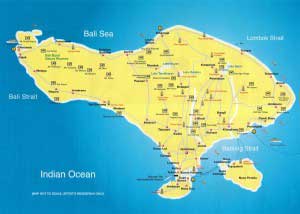
At first glance, the landscape of Nusa Penida seems to have little to offer. The hills have virtually been stripped bare of all trees, leaving behind a bizarre moon-like landscape of barren hills covered with alang-alang grass. Boulders are scattered around natural stone-walled pastures, and the tall vegetation gives off a lovely and all-pervading smell of lime. There appears to be not a great deal of adventure ahead for a true fan of unspoilt tropical surroundings. First impressions, however, are deceiving. The silence one finds on this island, the absence of noise and strangely comforting cool air in the higher regions, make the experience a special one. The views from such high vantage points as Puncak Mundi and Tunjuk Pusuh are breathtaking. There lies the island of Bali, shrouded in plumes of smoke from villages that line the southern coast, with the Badung Strait dividing the two islands. At midday, the panoramic view from the second-highest point of the island, Tunjuk Pusuh temple at some 450 metres above sea level, is awe-inspiring. One looks down on gliding green hills with terraced farming land, steeply rolling down towards the coast, underneath a blazingly blue, sun-lit sky with dramatic cloud formations during the wet monsoon. To the east, there is Lombok, quite clearly visible in fair weather. To the north, the faded contours of Mount Agung and the entire southern mountain range are visible, rendering this vista a near-magic one. After sunset, just take a minute to observe the comforting distance, and let yourself be transported by a unique feeling of detachment. Minutes before it becomes really dark, the cool evening breeze mixes with the sound of crickets chirping in the hills. One observes the twinkling lights of coastal towns such as Padangbai and, to the west, of Sanur and the crowded southern area around Kuta. One cannot help but feel elated at this sight, so close and yet so eternally far away from the hustle and bustle of mainland Bali glimmering in the distance.
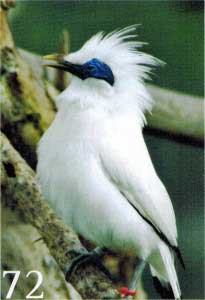
After having conquered a few miles of surprisingly smooth if, at times, frightfully steep and narrow tarmac roads leading to the interior, one discovers that the hills are, after all, not that blatantly naked. There are quite a number of undisturbed, pristine pockets of forest on the island. The total size of the forest on the island is 1,048 hectares, a mere 5% of Nusa Penida. Not something to boast about, but in reality there is much village forest still in good condition, sprawled out between farming areas, such as the forests near Tembeling, Tunjuk Pusuh and Puncak Mundi. The tiny hamlet of Penida in the far southwestern corner of the island is an absolute beauty, with not only pristine forest but a freshwater pool at the beach of Crystal Bay as well. One other fine example of natural and unspoilt forest is to be found near the village of Sekartaji, in the remote southeastern corner of Nusa Penida.
Birds
Sekartaji is also the home of the Lesser Sulphur-crested Cockatoo. At present, there are only four of these birds on the island, and three of these birds live in a gigantic, bright-red flowering ‘Stinky Sterculia’, a sacred tree just next to one of the temples. According to the local community, in the 1980s there were still quite a few of these birds around this village. However, the numbers of cockatoos dropped drastically since the bird was considered a pest. Scarce food crops such as corn were systematically plundered by large flocks of cockatoos.
At Tembeling, a long stretch of lush rainforest meanders down through the hills, from an altitude of around 200 meters towards the sea. One can start this walk from the back of Tembeling hamlet, where a spacious release enclosure for the Bali Starling was set up. From their home perch in a tall tree, two Rainbow Bee-eaters tumble down and nimbly snatch insects in mid-air. After a walk down through thick foliage along a narrow path, it is a true joy to bathe in the cool and shaded ‘temple’ pond fed by fresh water filtered through the limestone.
Raptors like the Brahminy Kite and the majestic White-bellied Sea-eagle are to be admired on top of the cliffs at Banah Point, on the south-west coast. The views from the steep cliffs over the ocean, with the waves down below breaking against the rocks, are spectacular. Birds-of-prey soar alongside the cliffs, virtually at eye level. In addition, there’s the Black-winged starling, once thought to be endangered, now to be found in their hundreds around the mangroves on Lembongan and elsewhere on Nusa Penida.
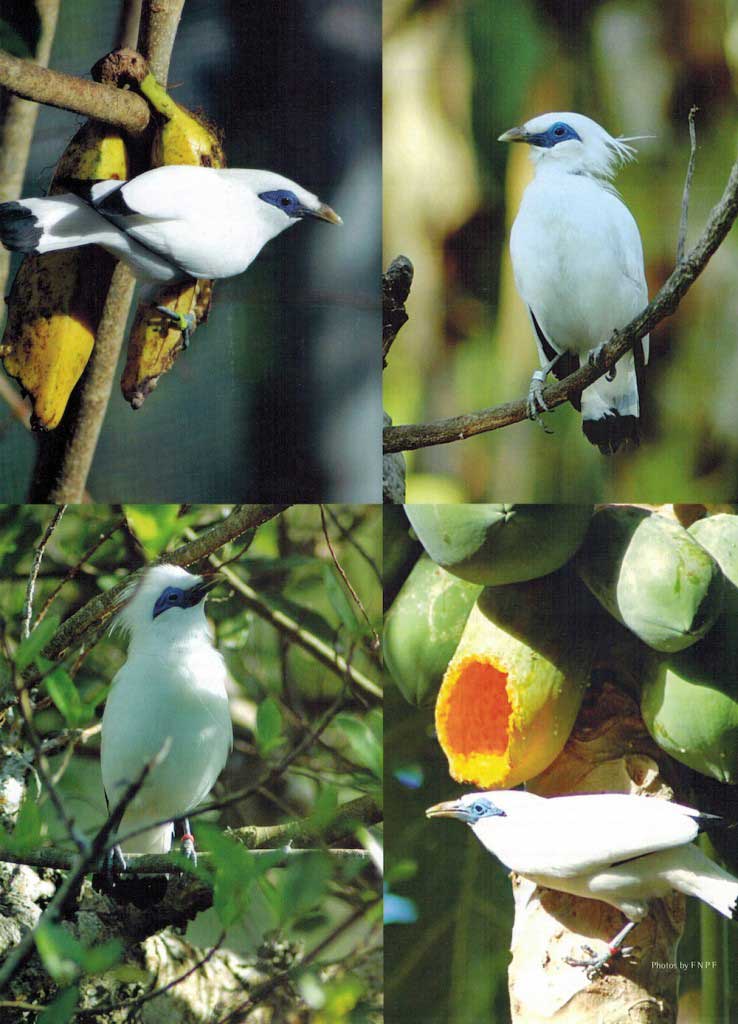
Amongst these birds, the Bali Starling is no doubt the most important representative of Bali’s fauna. To salvage this only Balinese endemic, and critically endangered bird, the Nusa Penida Bird Sanctuary has successfully introduced a conservation programme. The Sanctuary hosts breeding facilities for the Bali Starling, and has seen an incredible rate of chicks born in captivity. Up to the time of writing, a total of 50 birds born in captivity were released on Nusa Penida where they now are breeding in the wild. The first generation of seventeen wild birds are gaily populating their new habitat. A truly magnificent project that has deliberately opted for an alternative approach in protecting this vulnerable bird species against poachers, human greed and forest encroachment. The Bird Sanctuary has, in fact, chosen a radically new conservation approach. The natural habitat of this gem amongst birds is the West Bali National Park, not Nusa Penida. Many former conservation programmes have failed to succeed in preserving the Bali Starling in Bali and numbers in the wild dwindled to about five. These deploring results have inspired Bayu Wirayudha, Director of Friends of the National Parks Foundation and Begwawan Giri Foundation, with the idea of tackling the problem in rather a revolutionary way: a fully integrated approach that combines nature conservation and community development backed up by the islands traditional ‘awig-awig’ laws. In 2005, an all-encompassing agreement was reached between the conservation foundation, the religious authorities, the provincial government to implement an adat law that ordains a total ban on hunting birds on Nusa Penida. The link between religion, adat and strongly felt support given to the population of the island, has, in other words, created the ideal circumstances for this project to succeed.

The mostly poor population of Nusa Penida is assisted in their livelihoods procurement with trees and plants from the foundation’s nursery, both for production and reforestation purposes. The sanctuary donates life-stock, and schools across Nusa Penida get visits from especially trained teachers who have formulated a new nature conservation curriculum. In addition to the Bali Starling, other birds profit by these endeavours as well. The Lesser Sulphur-crested Cockatoo and the endangered Java Sparrow both get a chance of survival of this ‘reinvented’ natural environment. All of these feathered friends find a new and safe haven on Nusa Penida, and perhaps thanks to the Sanctuary‘s ‘holistic’ approach, the Bali Starling is again thriving. Presently, around 60 birds inhabit the island. Moreover, the birds are happy to see that the conservation programme has recently received a warm welcome by various institutions and officials, including the President of Indonesia Susilo Bambang Yudhoyono. He has confirmed his personal interest in this project by releasing 12 birds last April. This way, the once ill-fated island now seems to be on its way to becoming a better place for the local community and a natural haven for the birds.
All photographs by FNPF, Ubud, Bali – Indonesia (except for Garuda Magazine Cover, map of Bali)
Source
- Dijkman, G. – ‘Nusa Penida. A Safe Haven for the Bali Starling, The fabled mascot of Balinese fauna finds a new home’, Garuda Magazine, October 2007
Bali Starling: Rare Birds Yearbook 2008 (Hirschfeld/Dijkman)
Range & population
The starling is endemic to the island of Bali, Indonesia, where it formerly ranged across the north-west third of the island. It has perhaps long been uncommon, but the population has declined drastically and contracted its range. In the early 1900s, when it was discovered, the numbers have retrospectively been guessed at 300-900, although this is thought to be a gross underestimate. Illegal poaching reduced numbers to critically low levels in 1990. Conservation intervention coupled with the release of a few captive-bred birds raised this to between 35 and 55.

read more
However, despite excellent breeding success and continuing conservation efforts, including releases, the population continues to fluctuate. A second population on Nusa Penida island derived from 49 released individuals appears to have adapted to the island and is breeding. The total number to date of birds born in the wild on Nusa Penida is 16. A further 1,000 Bali Starlings are believed to survive in captivity. In the breeding season, which actually takes place in October and November, it inhabits fire-induced open shrub, tree and palm-savanna and adjacent closed-canopy monsoon-forest (tropical moist deciduous) below 175 m. In the non-breeding season, birds disperse into open forest edge and flooded savanna woodland. In the past they also occurred, and even nested, in coconut groves near villages. Previously thought to rely on cavities excavated and vacated by other birds, released individuals on Nusa Penida have nested in sugar palm, coconut, mangrove and fig trees.
Threats
Its decline to virtual extinction in the wild is primarily attributable to unsustainable, illegal trapping in response to worldwide demand for the cage-bird trade. This threat continues despite the fact that the whole population is now confined within a national park and has been the subject of a specific conservation programme. The park and programme have, however, suffered from repeated mismanagement and corruption. In 1999, while black-market prices soared (US$2,000 in mid-1990s), and armed gang stole almost all the 39 captive individuals in the park awaiting release into the wild. These serious problems now are compounded by habitat loss. With the population now at such a critically low level, other threats may include genetic erosion, inter-specific competition, natural predation and disease.
Conservation actions to date
The species has been protected under Indonesian law since 1970, while the remaining world population occurs entirely within Bali Barat National Park. Since 1983, the Bali Starling Project has helped to improve the guarding of the park, bolstered the wild population through release of captive-bred birds, and provided the foundation for the development of the Bali Starling Recovery Plan. It also appears to be benefiting from the efforts within the Nusa Penida Bird Sanctuary. Plans are being developed to legalise breeding and trading Bali Starling to open up the market and undermine illegal trade.
Population: 24 (declining)
History
- 1911 – German ornithologist Erwin Stresemann (1889-1972) collects the holotype and describers it the year after
- 1970 – the species becomes protected under Indonesian law.
- 1975 – 200 birds are estimated in September
- 1983 – the Bali Starling project is established
- 1990 – wild population estimated at c.15 birds.
- 1999 – and estimated 3,000 birds are in captivity, of which a third are registered in a studbook.
- 2001 – 6 birds are found
- 2005 – 24 individuals are recorded, following releases.
- 2006 – 37 birds are released in Nusa Penida.
- 2007 – 12 birds released in Nusa Penida and offered to the gods in religious ceremonies performed by Hindu priests. 10 birds bred in Japan are prepared for release in the West Bali National Park in May.
Conservation actions required
- Commence strict implementation of the Bali Starling Recovery Plan.
- Continue to monitor the success of the release and subsequent breeding of released birds in the wild on Nusa Penida, in particular investigating interactions with Black-winged Starling (Sturnus melanopterus).
Source
- text (2007) by Erik Hirschfeld
- contributions by Godi Dijkman
Bali mynah, brighter prospects for the future? (Dijkman, December 2014)
Godi Dijkman describes recent breeding and release developments of the Bali starling in 2014, in Nusa Penida and the West Bali National Park. Below article was published in BirdingASIA no. 22, December 2014, which only reached its readers by March 2015. Compared with the situation in 2007 (Dijkman, 2007), the overall status of the wild population of the Bali Myna Leucopsar rothschildi, talisman of Balinese fauna, has greatly improved. Numbers have risen in both the Taman Nasional Bali Barat (West Bali National Park) and Nusa Penida and the future for this charismatic bird looks brighter. Moreover, the success of the Bali Myna has had a positive impact on other species.
read more
Bali Myna (Leucopsar rothschildi)
Taman Nasional Bali Barat (TNBB) officials state that currently there are some 120 birds in the breeding centre there, whilst there are about 35 free-flying birds in the park, with an estimated total wild population in the area of about 40 birds. Various organisations are involved in the breeding and release programme, co-ordinated by the Bali Myna Conservation Association (APCB). Japan’s Yokohama Zoo has contributed birds for the breeding programme over the last few years, while Taman Safari Indonesia and Bali Bird Park have also participated in the conservation efforts. The present TNBB breeding programme commenced in 1996, with the first birds released into the park in 1998. Its main objective is to involve the local community around the park, including ex- poachers, in breeding the Bali Myna partly for commercial purposes and partly for release into the wild. So far, loans extended to breeding efforts are organised by the APCB. Since 2012, more than 60% of the birds bred by local communities have been released while simultaneously the restoration of the bird’s natural habitat is given priority. In 2015, TNBB hopes to achieve a total wild population of around 60 birds, but the attainment of this goal depends on the help of the local population to gradually return the habitat to its original state and ensure poaching and theft are stopped. One of the more daunting challenges is curbing the ubiquitous invasive Lantana camara, which often out-competes native plants, forming dense thickets if unchecked, leading to a reduction in biodiversity.
At present, on Nusa Penida (Dijkman 2007) there are reported to be some 100 free-flying Bali Mynas, including about 20 birds on Nusa Lembongan. Unfortunately in 2014, although there are an estimated 13 breeding pairs, only five chicks were successfully fledged in the wild – many others fell victim to predators and the climate. In 2013, estimated numbers were slightly higher and the reduction is believed to be due to several factors. Predators such as rats, monitor lizards (Varanus salvator), snakes and Tokay Gecko (Gekko gecko) steal eggs and prey on chicks in nest boxes and natural breeding sites. Brahminy Kites (Haliastur indus) and Changeable Hawk Eagles (Nisaetus cirrhatus) prey on adult birds. More surprisingly perhaps, Bali (p.106) Myna nests are taken over by honeybee colonies causing adults to desert them. However, the most voracious predator appears to be the Spotted Kestrel (Falco moluccensis), which, being about the same size as an adult Bali Myna, is well able to enter nest holes in search of prey. The weather on Nusa Penida, which is hot in comparison with mainland Bali, also takes a toll on chicks, which have been found dead after particularly cold nights, a common feature of the hot dry season. However, despite adverse weather and predatory animals, conditions on Nusa Penida are favourable, and for 2015 hopes are high for an increase in the free-flying population.
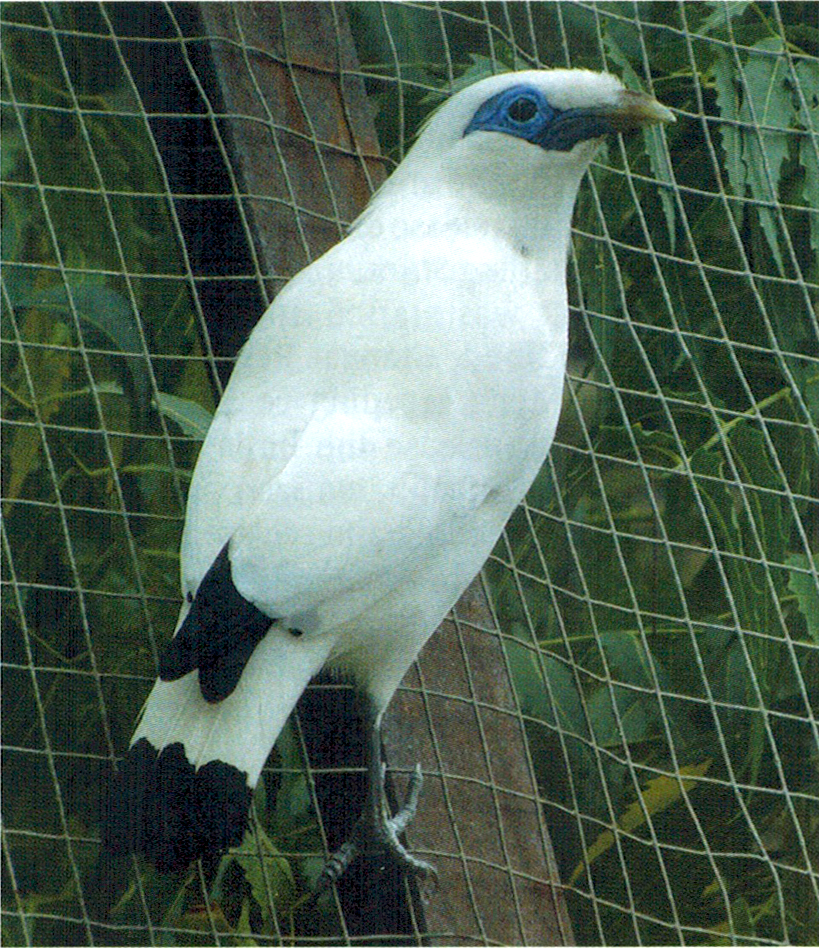
Bali Myna Leucopsar rothschildi, Taman Nasional Bali Barat, Indonesia, 19 July 2009 (James Eaton)
On Nusa Penida the species is found at Pura Puseh in the highlands, at Sental, around the Friends of the National Parks Foundation community centre at Ped (www.fnpf.org), at Sebunibus and on Nusa Lembongan. It prefers locations with medium-size trees which provide an abundance of different species of insects, as at Sebunibus. Nusa Lembongan has become a favourite Bali Myna site because the island is densely populated and the birds find easy meals in the form of temple offerings of rice and other edible items, as well as feeding on the many papaya trees, another favourite food, in the local gardens and on naturalised Jamaican cherry trees (Muntingia calabura). The mangrove forests on Lembongan, particularly at Puaji temple, Jungutbatu, offer a wide variety of insects and have also become a favourite habitat of the species. The Bali Myna has not yet spread to the higher altitudes on Nusa Penida such as the forested areas of Saab and Bukit Mundi with tall trees growing in the vicinity of the local temples, as it appears to prefer medium-sized trees, bushes and undergrowth.
As far as the anthropogenic factors contributing to the conservation of Bali Myna and other species are concerned, the traditional religious awig-awig code of conduct adhered to by the Hindu community on Bali greatly favours future success. In Balinese villages, two forms of governance work together in harmony to achieve a peaceful village life – the Bali provincial regulations based on the basic law of Indonesia and the traditional awig-awig village governance made through collective deliberation under the guidance of the religious leaders which is tailored to the conditions and circumstances in each village. In 2007, there were about 25 traditional villages adhering to these religious regulations, whereas in 2014, 46 are likely to adopt the awig-awig laws. The way these laws are maintained depends on the view taken by the community leaders of the presence of the Bali Myna in their village. In other words, the religious leaders hold the key to implementing these laws and sanctions, and despite rumours of illegal poaching there is no evidence for this occurring.
At the outset, there were critical comments on the effect the introduction of Bali Myna to Nusa Penida in 2006 might have on other bird species thought to be its natural competitors, including the Critically Endangered Black-winged Starling (Acridotheres melanopterus). At first, the Black-winged Starling only seemed to live around Wates, but recently it has been observed in other areas including Nusa Lembongan, in company with the White-vented (Myna A. javanicus), and the three starling species have been observed living together peacefully around Puaji temple at Jungutbatu where the larger trees provide numerous holes for nesting.
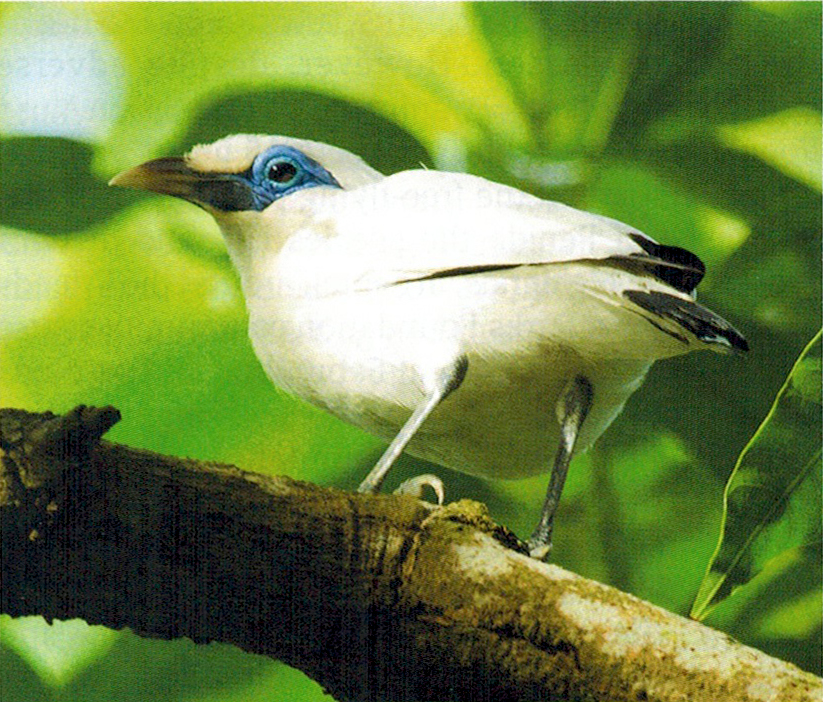
Bali Myna Leucopsar rothschildi, Nusa Penida, Indonesia, 27 May 2013 (Justin Raybouin)
The introduction of the Bali Myna to Nusa Penida has triggered interest in saving other bird species as well. Although initial attempts to reintroduce the Critically Endangered Yellow-crested Cockatoo (Cacatua sulphurea parvula) to the island were met with a positive attitude from the local population, for instance at Sekartaji, they failed due to predation by eagles. However, in the near future, attempts to breed this cockatoo are planned as large flocks of this bird once occupied the entire island. In 2007, the Near Threatened Scarlet-breasted Lorikeet (Trichoglossus forsteni mitchellii) population of ex-cage birds died out due to old age, but it is evident that this bird is perfectly able to survive on Nusa Penida. Previous attempts to revive the old numbers of the Vulnerable Java Sparrow (Lonchura oryzivora) have failed, but hopes are rising again due to its hitherto unsuspected ‘companions’ Dicrurus sp. which, thanks to their vigorous territorial behaviour, drive out the sparrow’s foremost enemy, the ubiquitous Long-tailed Shrike (Lanius schach).
The introduction of the Bali Myna to Nusa Penida has inspired other wildlife sanctuaries, such as the Besikalung Wildlife Sanctuary, near Jatiluwih, Batu Karu, Tabanan, initiated in 2011. Similar awig-awig religious governance to those on Nusa Penida also apply here and the area has been identified for future breeding and release of Black-winged Starling and Asian Pied Starling (Sturnus contra jalla). In 2014, a similar project was started at Pejeng Wildlife Sanctuary, near Ubud, Gianyar Regency, Bali. An additional Bali Myna breeding centre is planned here, expecting to release the birds in the wild, involving the local inhabitants who are willing to co-operate in the breeding and release project.
Recent information on breeding projects of this beautiful Balinese bird by the Begawan Foundation (Sibang, Bali) may be found at: www.begawanfoundation.org/?idm=8.
Reference
- Dijkman, G. (2007) – ‘Bali Myna (Leucopsar rothschildi) takes flight to Nusa Penida’, in: BirdingASIA 7, 2007: p.55-60
- Friends of the National Parks Foundation, FNPF (www.fnpf.org; Bayu Wirayudha), interview summer 2014
- West Bali National Park, TNBB (Nana Rukmana), interview summer 2014
Source
- Dijkman, G. (2014) – ‘Bali Myna (Leucopsar rothschildi): brighter prospects for the future?’; in: BirdingASIA 22, December 2014: p.105-106